What small business IT support actually covers
If you run a shop, a practice, or a nonprofit with a handful of computers, "IT support" can sound like a service built for companies ten times your size. It is not. Small business IT support is a specific, practical bundle of work, and once you can name what is in that bundle, you can tell in one phone call whether a provider is offering the real thing. Here is what the work actually is, what usually sits outside a plan, and the questions that separate real coverage from a logo on a ticket queue.
The short version
- IT support covers six jobs: security updates, backups, the network, email and accounts, the devices your people use, and monitoring that catches trouble early.
- Support is the ongoing work. Projects, like moving offices or building something new, are quoted separately by every honest provider.
- Most small business IT support plans are a flat monthly rate. Ours start at $150 a month, and the comparison with hourly break-fix and hiring in-house, with the numbers attached, is in our managed IT services guide.
- Every job on the list comes with a question you can ask any provider. The answers tell you more than any brochure will.
The six jobs small business IT support actually does
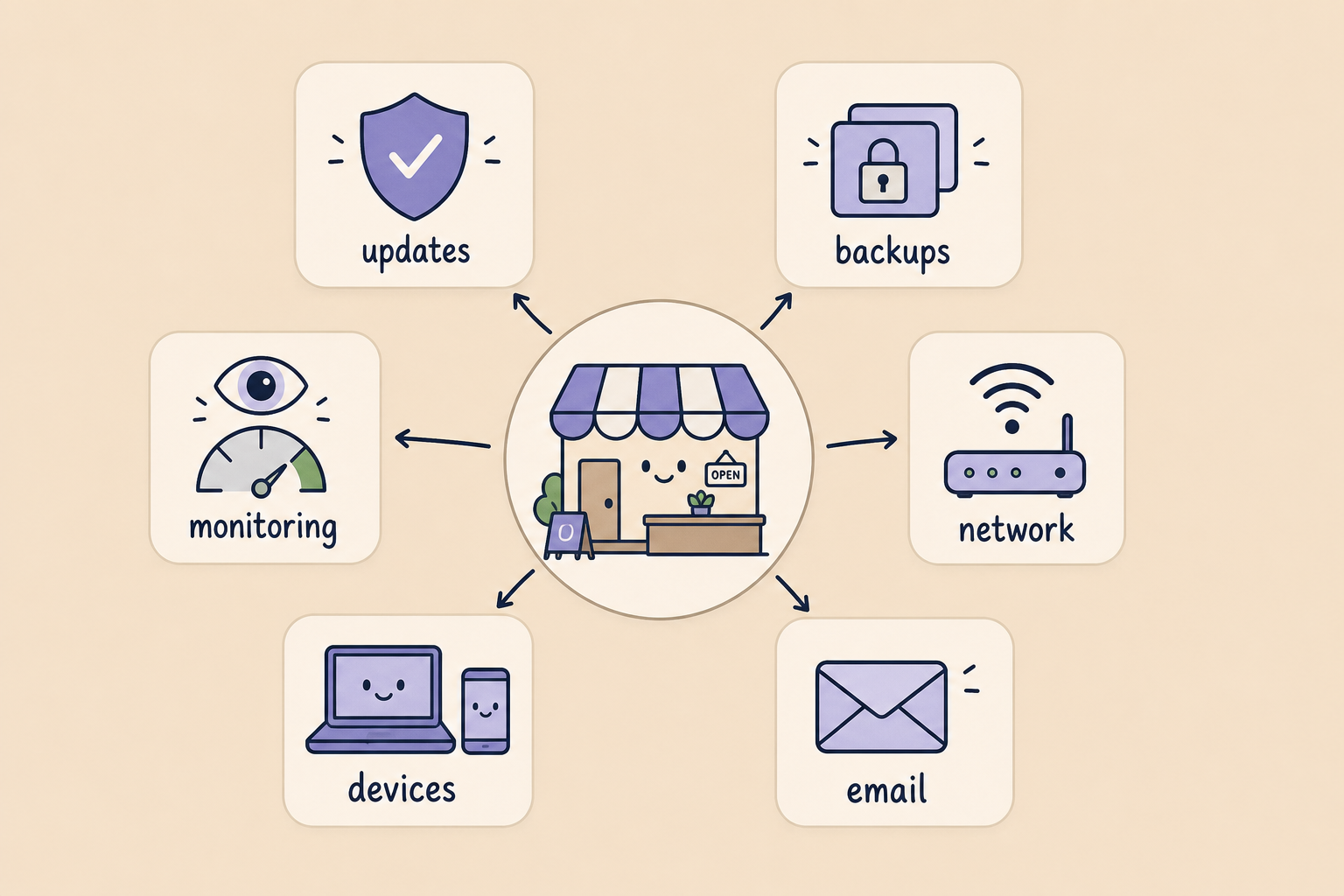
Every real plan covers the same six jobs, so the list alone will not tell providers apart. What separates them is how seriously each job is done. Alongside each one, here is the question that shows you, in about a minute, whether you are buying the real thing.
- Security updates. Every computer, router, and program patched on schedule, checked afterward, and recorded. The question to ask: how do you know an update took, and what got patched last month? A real plan has that record and can show you.
- Backups. Copies made on schedule, verified, and actually restored from now and then to prove the whole path works. The question: when was my last test restore? If the answer is a pause, the backups are a hope, and hope is not a plan.
- The network. Wifi that reaches every corner, the firewall and router kept current, wiring that does not turn a new desk into a project, and remote access that does not open a hole. The question: is network work part of the plan, or billed by the hour when the wifi drops?
- Email and accounts. Microsoft 365 or Google Workspace kept working, with accounts opened when people join and closed when they leave. The question: what happens the day someone leaves? An account nobody closed is an open door with last year's name on it.
- Devices. The laptop that will not start before a deadline, the printer that vanished from the network, the password that expired at the worst moment. The question: what does a password reset cost me? In a flat plan the answer is nothing, and it is sorted in minutes.
- Monitoring. Your systems watched around the clock, so trouble is caught while it is still a note in a log instead of a bad Tuesday. The question: how would you know my backup failed before I do? If there is no crisp answer, nobody is watching.
What a plan usually does not cover
The line between what IT support covers and what gets quoted separately is simple: support keeps what you have working, and projects change what you have. A new office network, a move, new software for the whole team, a website build: those are projects, and an honest provider tells you the number before starting rather than folding surprises into a monthly bill. Physical installation trades are outside the bundle too. Running cable through walls or mounting security cameras is licensed low-voltage work, a different trade from IT support, and a provider who claims one flat fee covers everything is worth pressing on what everything means, in writing.
How the work gets done here
On our plans, an AI agent takes each ticket the moment it lands, works out what is wrong, and prepares the fix. A person on our team checks and approves it before anything changes on your systems: the agent works read-only until a human signs off, and every change is approved, logged, and reversible. One supervisor overseeing many jobs at once is why the plans stay flat instead of running on an hourly meter, and because we live here, if the trouble is in the hardware, we come and put hands on it. The full picture, including what happens when you call and what the local service looks like, is on our IT support in Port St. Lucie page.
Five questions to ask any provider, and our answers
The six questions above test the coverage. These five test the company.
- Who, by name, is accountable for my account? Here, a named person on our team owns your account, approves every change, and answers when you call.
- What happens after hours? Our AI agents watch and act at any hour, with a person approving anything that changes a system. You are not paying a night shift to sit idle, and you are not unprotected at 2 a.m. either.
- What is included, and what is quoted separately? The six jobs are the plan. Projects get a number up front, before we touch anything.
- Are changes logged, and can they be undone? Every change here is approved by a person, written down, and reversible. You can ask what was done and why, and get a straight answer.
- Will you come on site? Yes. We are in and around Port St. Lucie, Fort Pierce, Stuart, and Vero Beach, and when a problem needs hands on the hardware, ours are close.
Common questions
Is five computers too small for IT support? No. The six jobs exist at every size; a smaller setup simply takes fewer hours, which is what a flat plan prices in. IT support coverage for the smallest offices usually starts with the two jobs that hurt most when skipped: backups and updates.
Is "IT support" different from "managed IT services"? In everyday use they overlap almost completely. "Managed" usually signals the flat-monthly, ongoing model rather than pay-by-the-hour repairs. Our managed IT services guide walks through the models side by side, with costs.
Do I need to replace anything to start? No. Good support starts with writing down what you already have and how it connects. There is no rip-and-replace, and if you are leaving another provider, the handoff is our job, not yours.
The straight version
You do not need to become your own IT department, and you do not need a lecture about technology to buy small business IT support well. Know the six jobs, ask the eleven questions, and get the answers in writing. Any provider worth hiring will welcome them, and we would be glad to answer every one. Get IT help whenever you are ready. If you want to get the basics right yourself first, the government keeps a plain guide to small business security.