Is AI worth it for a small business? An honest answer
Is AI worth it for a small business? You have probably heard both answers, loudly. One crowd says it will change everything by next spring. The other says it is a fad that makes things up. If you run a shop, a trade, a clinic or a nonprofit here on the Treasure Coast, neither crowd helps much. You want to know whether it would earn its keep in your business, this year, at a price you can see.
We build AI agents for local businesses, so weigh our answer with that in mind. Here it is anyway: sometimes yes, often not yet, and you can find out which on one job before you spend much.
The short version
- AI earns its keep on work that repeats, follows rules, and lives in software you already use.
- It is a poor fit, for now, for work that runs on judgment, trust, paper, or a handshake.
- Start with one agent on one job, set to ask you before it acts, and judge it by the hours you get back.
- Safety comes first: every agent we build is kept inside what we call the three Cs.
- AI help from us starts at $150 a month, and you can turn it off at any time.
A chatbot and an agent are different tools
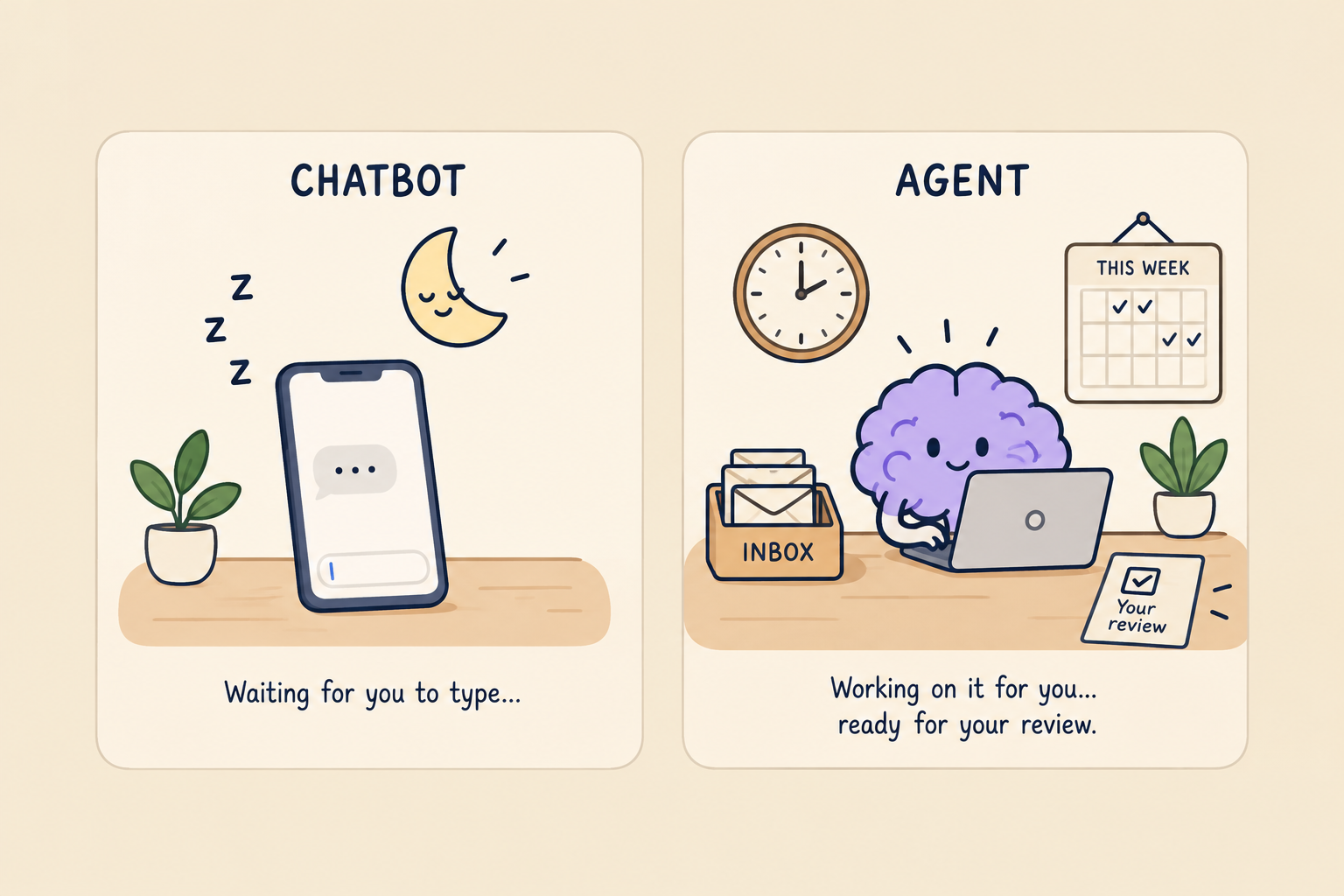
Most people's first taste of AI is a chatbot. It lives in an app on your phone or computer, sits idle until you type a question, answers it, and waits for the next one. That is handy for a quick question, and it only works while you are there to ask.
“Agent” is the newer word, and it means something different. An agent is always on, or on for the hours you choose. It starts work by itself: when a new email lands, when a bill arrives, when Monday morning comes around. It works from written instructions about your business, carries the job through, and brings you what needs your yes. When we talk about AI for a small business, an agent is what we mean.
Where AI pays its way
Look for three things in a job. It comes around every day or every week. It follows rules you could write down for a new hire. And the work happens inside software: your accounting, your email, your customer list, your spreadsheets, your booking calendar.
When a job has all three, an agent can usually take a real share of it. A few examples:
- Posting receipts and bills to your books.
- Sorting the inbox, filing what belongs in a folder, and drafting replies to the questions you answer every week.
- Keeping customer records up to date after a call or a job.
- Pulling the same numbers into the same report every Monday.
- Reading a new job request by email and drafting the estimate for you to check.
None of these is the reason you went into business. They are the work that piles up around it, and that pile is where AI does its best work.
Where it is not worth it yet
Here is the other half, and it matters just as much.
Work that runs on judgment or trust. Pricing a tricky job, calming an upset customer, deciding who to hire. AI can gather the facts or draft a first pass. The call stays yours, and it should.
Jobs that come up twice a year. Setting up an agent for a rare task costs more than doing it by hand. Save it for the work that never stops.
Work that lives on paper or in your head. AI works inside software. If the records are in a binder in the back office, getting them into a system comes first, and that is a separate decision.
Weeks when nobody can check on it. At the start, an agent that asks before it acts needs someone to say yes. If the next month is your busy season, start after it.
A nagging feeling that you should. If the only reason is that everyone seems to be talking about it, wait until you have a job in mind. A tool with no job is just another monthly bill.
How to tell if it would pay for itself
You can do this on the back of an envelope.
- Pick one job from the list above that eats time in your week.
- Write down roughly how many hours it takes each week, and who does it.
- Put a value on an hour of that person's time.
- Compare the hours times the value against the monthly cost.
If the person doing the job is you, count your hours at more than the wage math says. An hour you spend posting receipts is an hour you are not quoting work, visiting a customer, or getting home on time.
Then count what never shows up on a timesheet: the invoice that went out a week late, the email answered the next afternoon, the shoebox of receipts at tax time. Those costs are real, even if no one writes them down.
Safety is important: the three Cs
Letting software into your books is a big ask, so safety is where we start. No AI reads perfectly every time, which is why we never lean on a single safeguard. Every agent we build sits inside three layers we call the three Cs.
Context. It works from written instructions about its job and your business, plus the files that job needs, and nothing else. Whatever it reads along the way, a customer's email or a vendor's invoice, is information for the job. None of it is a new set of orders.
Container. It runs on a server of its own, apart from the computers your people use, so it never has the run of your files, your saved logins, or your office network.
Credentials. It holds only the logins and permissions its job needs. It cannot reach past its job or borrow another agent's tools, even when both work for you.
The layers overlap on purpose. If an agent misreads a cleverly worded email, it still has only its own instructions, off your computers, with only the permissions its job was given. Our page on how an agent is kept inside the lines you set walks through each layer.
Safety also means looking after it. Your business changes, your software changes, and the instructions an agent works from have to change with them. We keep those instructions fresh, and the agents we host keep a detailed log of what they did, so you can always see what happened and when.
Approval modes: how much it does on its own
Every agent has an approval mode, a setting for which of its actions wait for your yes. You choose it, and you can change it whenever you like.
Manual. Every action waits for you. It drafts the estimate or prepares the journal entry from a receipt, and nothing goes out until you approve it. Every agent we build starts here.
An approved list. You name the routine actions it may take on its own, such as filing a receipt or updating a customer record after a job. Anything not on the list still waits for you.
Auto. A classifier, a separate check that looks at each action before it happens, sorts the routine from the unusual. Routine work goes ahead. Anything risky, or outside the agent's job, stops and waits for you.
Whether an agent may send, publish, or spend anything on its own is your call in every mode. A sensible path is to start in manual, move a routine job onto the approved list once it has earned your trust, and save auto for work that is frequent and low in stakes.
How we build an agent for you
An agent is one AI worker with one job. What you pay us for is the care that goes into each one, in three parts.
Trained. Every agent starts from written instructions: what the job is, how your business runs, how you talk to your customers, and the rules your line of work follows. We keep those instructions fresh as your business changes.
Provisioned. It runs on a server of its own, with the logins its job needs and no others. If you want, it can have its own email address and phone number.
Scoped. It sees only what its job needs, and its approval mode sets how much it does without asking.
We start with one agent on one job, in manual mode, so it drafts and you approve. After a few weeks you will know how many hours it gives back. Then you decide whether to keep it as it is, give it more room, add a second agent, or turn it off. If it is not earning its place, we will tell you so.
You can read more about the range of what we build, from a single agent to a whole team, in our guide to AI help in Port St. Lucie.
What it costs
AI help starts at $150 a month and scales with how many agents you run and what each one does. We tell you the number and what drives it before you commit. It is easy to add a second agent and a third before the first has proved itself, so we add more only as each one earns its place. You can see how we lay out our AI services on our AI page.
Common questions
Will AI replace my staff? It clears the busywork so your people can spend their day on the work that needs a person.
What exactly is an agent? One AI worker with one job, its own instructions, and the logins that job needs. Unlike a chatbot, it starts work by itself. A small business might start with one. A bigger one might run a team, each agent with its own name and job.
Do I need to be technical? No. You describe the job in plain English, and we handle everything underneath.
What if I try it and it does not help? Turn it off. You can do that at any time, and we would rather you did than pay for something that is not working.
Is it safe to let it into my books? Safety is where we start. The three Cs keep each agent to its own instructions, its own server, and only the logins its job needs, and its approval mode decides what waits for you. The three Cs page explains each safeguard.
So, is AI worth it for a small business?
For the right job, yes. For the wrong one, no, and we would rather tell you that up front. Sit down with us in person, here on the Treasure Coast, bring the job that eats your week, and we will give you a straight answer about whether AI would earn its keep there. Talk to us about AI whenever you are ready.